
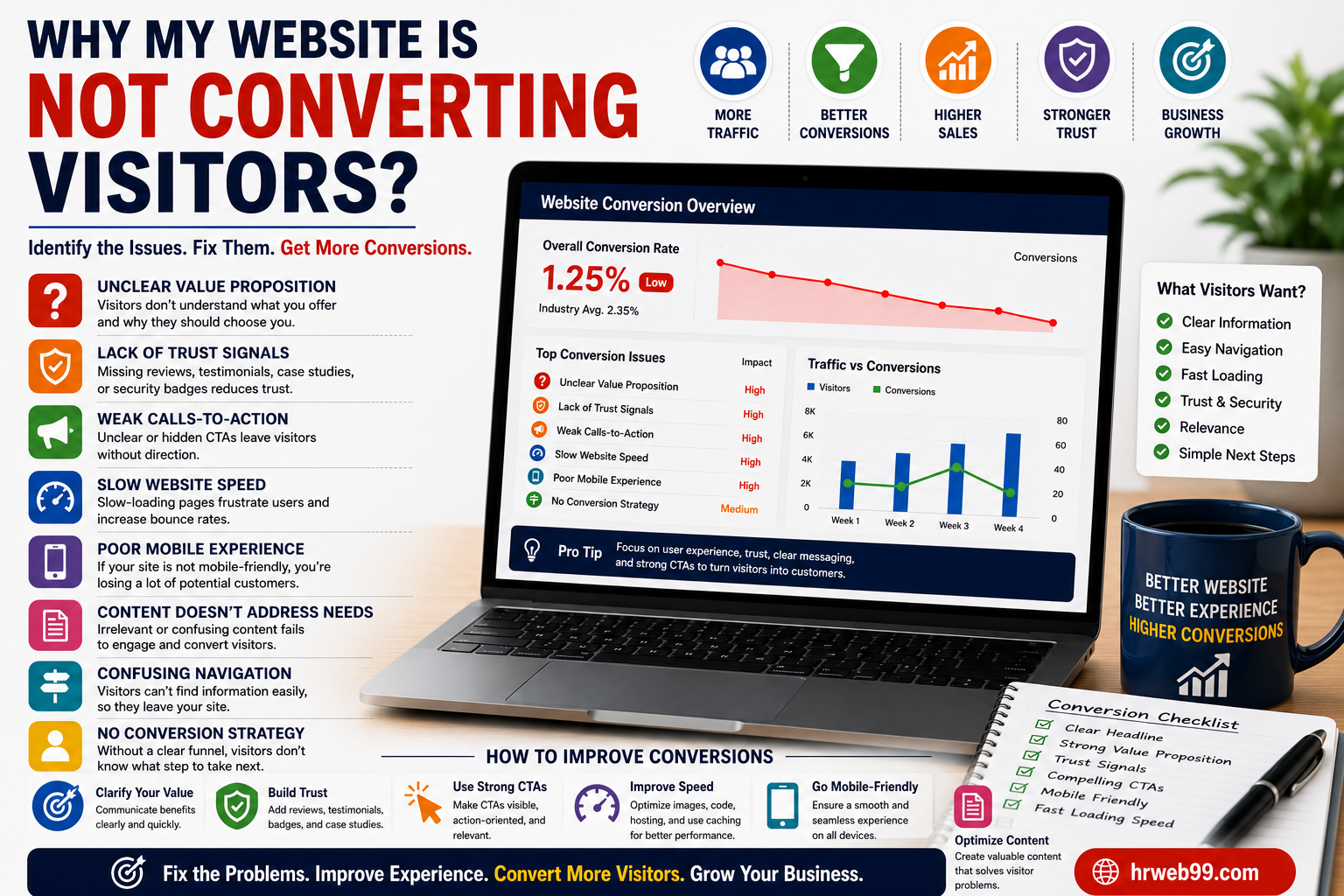
Why My Website Is Not Converting Visitors
Many business owners invest heavily in website design, SEO, content creation, and digital marketing campaigns with the expectation of generating leads and sales. However, despite receiving a steady flow of visitors, they often find themselves asking an important question: Why My Website Is Not Converting Visitors?
Traffic alone does not guarantee business success. The true value of a website lies in its ability to turn visitors into customers, subscribers, leads, or inquiries. If users arrive on your website but leave without taking action, there is likely a problem somewhere within your conversion process.
Understanding Why My Website Is Not Converting Visitors requires analyzing the entire customer journey, from the moment someone lands on your website until they decide whether to take action. Small issues related to design, messaging, trust, speed, usability, or content can significantly impact conversion rates.
The good news is that most conversion problems can be identified and corrected. Businesses that continuously optimize their websites often achieve better engagement, stronger lead generation, and increased sales.
Common Reasons Why My Website Is Not Converting Visitors
Many websites fail to convert because they focus on attracting traffic without paying enough attention to user experience and conversion optimization.
Your Value Proposition Is Not Clear
When visitors arrive on your website, they should immediately understand:
- What your business offers
- Who your services are for
- Why customers should choose you
- What benefits you provide
If visitors cannot quickly understand your value proposition, they are likely to leave and continue searching elsewhere.
A strong value proposition should appear prominently on the homepage and key landing pages. Clear messaging helps visitors understand why your solution is relevant to their needs.
Visitors Do Not Trust Your Website
Trust is one of the most important factors in online conversions.
Potential customers are often cautious when interacting with unfamiliar businesses. If your website lacks credibility indicators, visitors may hesitate to contact you or make a purchase.
Important trust signals include:
- Customer testimonials
- Reviews
- Case studies
- Industry certifications
- Secure payment badges
- Business contact information
A trustworthy website reassures visitors that they are dealing with a legitimate and reliable company.
Website Design Looks Outdated
Visual appearance significantly influences visitor perception.
An outdated design can make users question your professionalism and expertise.
Common design issues include:
- Cluttered layouts
- Poor typography
- Inconsistent branding
- Low-quality images
- Confusing page structures
Modern and user-friendly websites create stronger first impressions and encourage visitors to engage further.
Businesses seeking professional solutions may benefit from services such as https://hrweb99.com/custom-website-design to create conversion-focused website experiences.
Slow Website Loading Speed
Website speed directly affects conversion rates.
Visitors expect pages to load quickly. Even small delays can lead to frustration and abandonment.
Slow-loading websites often suffer from:
- Large image files
- Excessive scripts
- Poor hosting services
- Unoptimized code
Businesses can evaluate performance using tools such as Google PageSpeed Insights and implement recommended optimizations.
Faster websites generally achieve higher engagement and better conversion outcomes.
Weak Calls-to-Action
Many websites fail because visitors do not know what action to take next.
Calls-to-action guide users through the conversion process.
Examples include:
- Request a Quote
- Schedule a Consultation
- Contact Us Today
- Start Your Project
- Get a Free Assessment
Without clear calls-to-action, visitors may leave even if they are interested in your services.
Effective calls-to-action should be:
- Easy to find
- Action-oriented
- Relevant to user intent
- Visually noticeable
Content Does Not Address Visitor Needs
Content should focus on solving customer problems rather than simply describing products or services.
Visitors want answers to questions such as:
- How can this help me?
- What problem does it solve?
- Why should I trust this company?
- What results can I expect?
Content that fails to address user needs often results in low engagement and poor conversion rates.
Poor Mobile Experience
A significant portion of internet traffic now comes from mobile devices.
If your website is difficult to use on smartphones or tablets, visitors may leave before taking action.
Common mobile issues include:
- Small text
- Broken layouts
- Difficult navigation
- Slow performance
- Poor form usability
Responsive design ensures a consistent and enjoyable experience across all devices.
Too Many Distractions
Visitors should remain focused on the primary objective of each page.
Excessive distractions can reduce conversions, including:
- Too many pop-ups
- Auto-playing media
- Excessive advertisements
- Complicated navigation
A clean and focused layout helps guide users toward desired actions.
Lack of Social Proof
People often rely on the experiences of others before making decisions.
Social proof helps reduce uncertainty and build confidence.
Examples include:
- Customer reviews
- Testimonials
- Success stories
- Client logos
- Case studies
The absence of social proof may cause visitors to question whether your products or services deliver real results.
Complicated Forms
Lead generation forms should be simple and user-friendly.
Long or complicated forms often discourage visitors from completing them.
Best practices include:
- Request only necessary information
- Keep forms short
- Use clear labels
- Minimize required fields
Reducing friction increases the likelihood of conversions.
Visitors Cannot Find Information Quickly
Users expect websites to provide information quickly and efficiently.
Poor navigation can make it difficult for visitors to find:
- Services
- Pricing
- Contact information
- Product details
- Support resources
Simple navigation structures improve usability and encourage deeper engagement.
No Conversion Funnel Strategy
A conversion funnel guides visitors toward a specific goal.
Many websites lack a structured process for moving users from awareness to action.
An effective funnel typically includes:
- Awareness
- Interest
- Consideration
- Decision
- Action
Without a clear funnel, visitors may leave before completing desired actions.
Landing Pages Are Not Optimized
Landing pages play a crucial role in conversions.
Poor landing pages often suffer from:
- Weak headlines
- Irrelevant content
- Unclear benefits
- Poor design
- Missing calls-to-action
Optimized landing pages focus on a single objective and guide users toward conversion.
Pricing Information Is Unclear
Customers often want transparency regarding costs.
When pricing information is difficult to find or understand, visitors may leave to compare competitors.
Businesses can improve conversions by providing:
- Pricing details
- Package options
- Service explanations
- Quote request opportunities
Transparency helps reduce uncertainty.
Lack of Personalization
Visitors appreciate experiences that feel relevant to their needs.
Personalization may include:
- Targeted content
- Relevant recommendations
- Industry-specific messaging
- Customized offers
Personalized experiences often result in stronger engagement and higher conversion rates.
Technical Problems Affect User Experience
Technical issues can damage visitor confidence and reduce conversions.
Examples include:
- Broken links
- Form errors
- Missing images
- Security warnings
- Server downtime
Regular maintenance helps ensure a smooth user experience.
Poor Search Intent Alignment
Visitors arrive with specific expectations.
If your content does not align with their intent, they are unlikely to convert.
For example:
- Informational searches require educational content.
- Commercial searches require product or service details.
- Transactional searches require conversion-focused pages.
Matching user intent improves engagement and conversion potential.
Failure to Analyze Visitor Behavior
Many businesses fail to understand how users interact with their websites.
Analyzing visitor behavior helps identify obstacles and opportunities for improvement.
Important metrics include:
- Conversion rates
- Bounce rates
- Session duration
- Exit pages
- User flow
Tools such as Google Analytics provide valuable insights into visitor behavior and website performance.
According to recommendations from Google Search Central, businesses should focus on creating helpful, user-centered experiences that provide genuine value.
Businesses asking Why My Website Is Not Converting Visitors often discover that the issue is not traffic volume but rather a combination of user experience, trust, messaging, and conversion optimization challenges.
A successful website should guide visitors through a seamless journey that builds confidence, addresses concerns, and encourages action. Every element—from design and content to navigation and speed—plays a role in influencing conversion rates.
Organizations that regularly test, analyze, and improve their websites often achieve significant gains in lead generation and customer acquisition. Understanding Why My Website Is Not Converting Visitors allows businesses to identify weaknesses and implement effective solutions that improve performance.
Ultimately, the answer to Why My Website Is Not Converting Visitors lies in creating a user-focused experience that delivers value, establishes trust, and makes it easy for visitors to become customers. When these elements work together effectively, websites become powerful tools for generating leads, increasing sales, and supporting long-term business growth.



Leave a Reply