
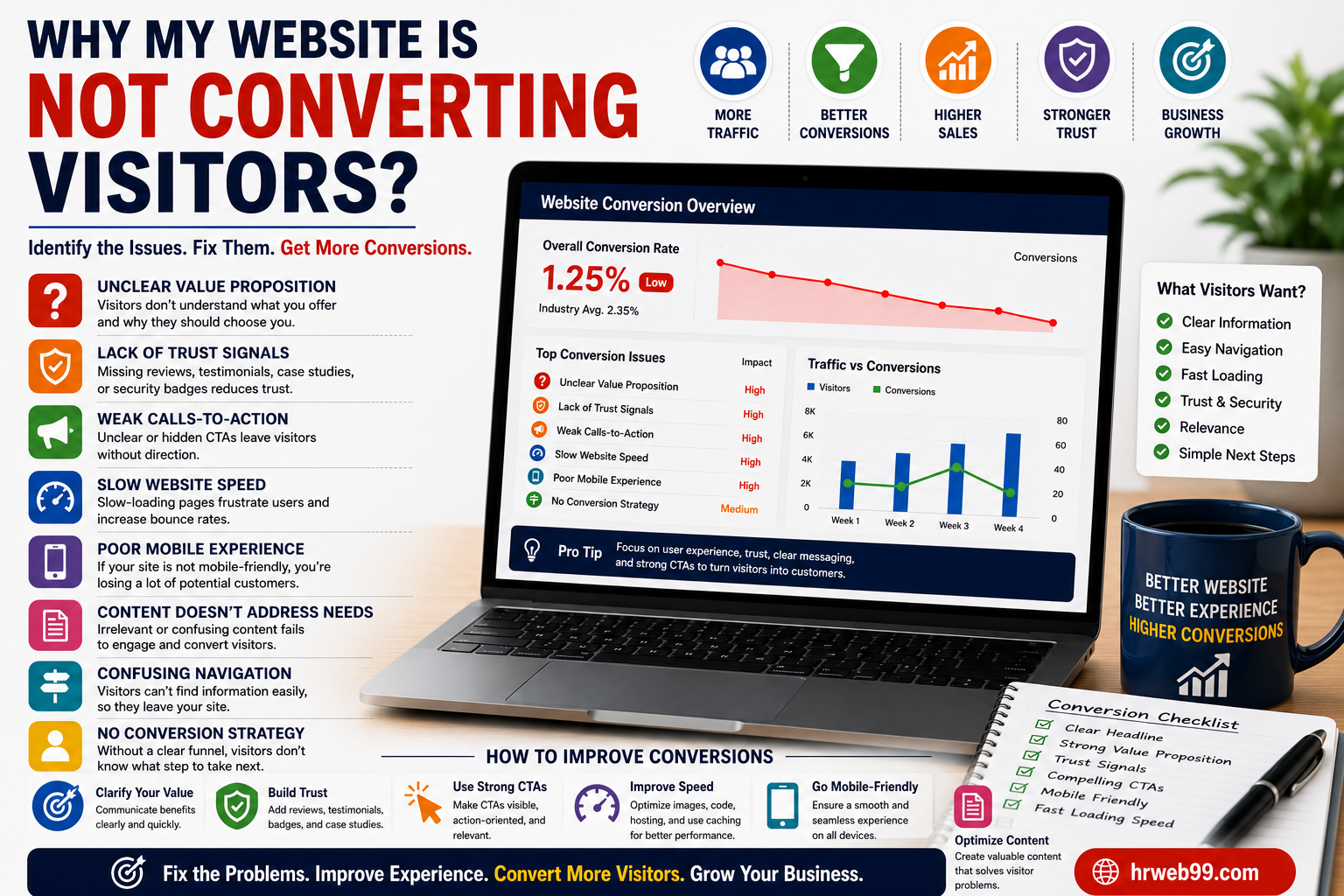
Why My Website Is Not Converting Visitors
Many business owners celebrate when they see traffic coming to their website. However, traffic alone does not guarantee business success. A website may attract hundreds or even thousands of visitors every month, yet fail to generate inquiries, leads, or sales. This often leads to a common and frustrating question: Why My Website Is Not Converting Visitors?
A website should do much more than simply attract visitors. Its primary purpose is to guide users toward a desired action, whether that means making a purchase, requesting a quote, booking a consultation, subscribing to a newsletter, or contacting your business. If visitors are arriving but leaving without taking action, something within the website experience is preventing conversions.
Understanding Why My Website Is Not Converting Visitors requires examining several factors including user experience, website design, trust signals, content quality, page speed, and overall conversion strategy. Small issues can create significant barriers that prevent users from becoming customers.
Businesses that identify and fix these obstacles often experience dramatic improvements in lead generation, customer engagement, and revenue growth.
Common Reasons Why My Website Is Not Converting Visitors
Website conversions are influenced by many different factors. Improving conversion rates starts with understanding where visitors are dropping off and what is preventing them from taking action.
Visitors Do Not Understand What You Offer
One of the most common reasons websites fail to convert is unclear messaging.
When users land on your website, they should immediately understand:
- What your business does
- Who your services are designed for
- What problem you solve
- Why customers should choose you
If visitors need to spend several minutes figuring out what you offer, they are likely to leave.
A strong value proposition should be visible at the top of important pages and communicate benefits clearly and concisely.
Your Website Looks Unprofessional
First impressions have a significant impact on conversion rates.
Visitors often judge a business within seconds based on website appearance alone.
Common design problems include:
- Outdated layouts
- Poor color combinations
- Low-quality images
- Inconsistent branding
- Cluttered pages
A professional website creates trust and encourages visitors to explore further.
Businesses looking to improve credibility and conversions can benefit from solutions such as https://hrweb99.com/custom-website-design that focus on user experience and business growth.
Lack of Trust Signals
Trust plays a critical role in online decision-making.
Visitors are often cautious when interacting with unfamiliar businesses.
Without trust indicators, users may hesitate to contact your company or purchase your products.
Effective trust signals include:
- Customer testimonials
- Online reviews
- Case studies
- Client logos
- Security certificates
- Industry certifications
These elements reassure visitors that your business is legitimate and reliable.
Slow Website Loading Speed
Website speed directly impacts user behavior.
Research consistently shows that visitors abandon websites that take too long to load.
Slow websites often suffer from:
- Large image files
- Poor hosting infrastructure
- Excessive scripts
- Unoptimized code
Businesses can analyze performance using tools such as Google PageSpeed Insights.
Faster websites generally achieve better engagement and conversion rates.
Weak Calls-to-Action
Many websites fail because visitors are not guided toward a next step.
A call-to-action tells users exactly what to do.
Examples include:
- Request a Free Quote
- Contact Us Today
- Schedule a Consultation
- Start Your Project
- Learn More
Without strong calls-to-action, visitors may leave even when they are interested in your services.
Clear, visible, and action-oriented CTAs significantly improve conversion opportunities.
Poor Mobile Experience
Mobile devices now generate a large percentage of website traffic.
If your website does not function properly on smartphones and tablets, visitors may abandon it quickly.
Common mobile issues include:
- Small text
- Difficult navigation
- Slow performance
- Broken layouts
- Hard-to-use forms
Responsive design helps ensure a seamless experience across all devices.
Content Does Not Solve Visitor Problems
Many businesses focus too heavily on describing themselves rather than addressing customer needs.
Visitors typically want answers to questions such as:
- How can this service help me?
- What results can I expect?
- Why should I trust this company?
- What makes this solution different?
Content should focus on solving problems and providing value.
According to guidance from Google Search Central, helpful and user-focused content contributes to stronger engagement and better website performance.
Visitors Cannot Find Information Easily
Confusing navigation can create frustration and reduce conversions.
Important information should be easy to locate, including:
- Service pages
- Pricing information
- Contact details
- About Us content
- Frequently asked questions
Simple navigation encourages visitors to explore more pages and engage with your business.
Forms Are Too Complicated
Lead generation forms should be simple and easy to complete.
Many websites lose potential customers because forms request too much information.
Best practices include:
- Fewer required fields
- Clear instructions
- Mobile-friendly design
- Simple layouts
Reducing friction increases form completion rates.
No Clear Conversion Funnel
Visitors need a structured path that guides them from awareness to action.
A conversion funnel typically includes:
- Awareness
- Interest
- Consideration
- Decision
- Action
Many websites fail because they do not provide a logical progression through these stages.
An optimized funnel helps move visitors toward becoming customers.
Lack of Social Proof
People often rely on the experiences of others before making decisions.
Social proof reduces uncertainty and builds confidence.
Examples include:
- Customer reviews
- Testimonials
- Success stories
- Project portfolios
- Ratings and awards
Websites without social proof may struggle to establish credibility.
Pricing Is Unclear
Many visitors leave websites because they cannot determine pricing expectations.
Businesses do not always need to publish exact prices, but providing:
- Price ranges
- Service packages
- Cost explanations
- Quote request options
can help reduce uncertainty and improve conversions.
Landing Pages Are Not Optimized
Landing pages play a crucial role in conversion success.
A poorly optimized landing page may include:
- Weak headlines
- Irrelevant content
- Confusing messaging
- Poor design
- Missing calls-to-action
Landing pages should focus on a single objective and guide users toward taking action.
Too Many Distractions
Visitors can become overwhelmed when websites contain excessive distractions.
Examples include:
- Multiple pop-ups
- Auto-playing videos
- Too many advertisements
- Excessive animations
A clean and focused design helps visitors remain engaged and move toward conversion goals.
No Competitive Advantage
Potential customers often compare multiple businesses before making a decision.
If your website does not clearly explain why customers should choose your company, visitors may leave for competitors.
Competitive advantages may include:
- Industry expertise
- Faster service
- Better support
- Proven results
- Unique solutions
Clearly communicating these benefits helps improve conversions.
Technical Issues Reduce Confidence
Technical problems can negatively affect both user experience and trust.
Examples include:
- Broken links
- Missing images
- Error messages
- Form failures
- Security warnings
Regular maintenance helps ensure a smooth and professional experience.
Failure to Monitor User Behavior
Many businesses struggle because they do not understand how visitors interact with their websites.
Analyzing visitor behavior can reveal:
- High-exit pages
- Drop-off points
- Popular content
- Conversion obstacles
Tools such as Google Analytics provide valuable insights that support conversion optimization efforts.
Lack of Personalization
Visitors are more likely to engage when content feels relevant to their needs.
Personalization strategies may include:
- Industry-specific messaging
- Customized recommendations
- Targeted landing pages
- Location-based content
Relevant experiences help improve engagement and conversion rates.
Businesses asking Why My Website Is Not Converting Visitors often discover that multiple small issues combine to create significant conversion challenges. Improving conversion rates requires a comprehensive approach that addresses user experience, trust, performance, content, and design.
A successful website should guide visitors through a clear journey that builds confidence and encourages action. Every element—from page speed and navigation to messaging and social proof—plays an important role in influencing user decisions.
Organizations that regularly optimize their websites often experience stronger lead generation, higher customer satisfaction, and improved business performance. Understanding Why My Website Is Not Converting Visitors allows businesses to identify weaknesses and implement practical solutions that support long-term growth.
Ultimately, the answer to Why My Website Is Not Converting Visitors lies in creating a website that understands visitor needs, delivers value, builds trust, and removes obstacles from the conversion process. When these elements work together effectively, websites become powerful tools for generating leads, increasing sales, and driving sustainable business success.


Leave a Reply