
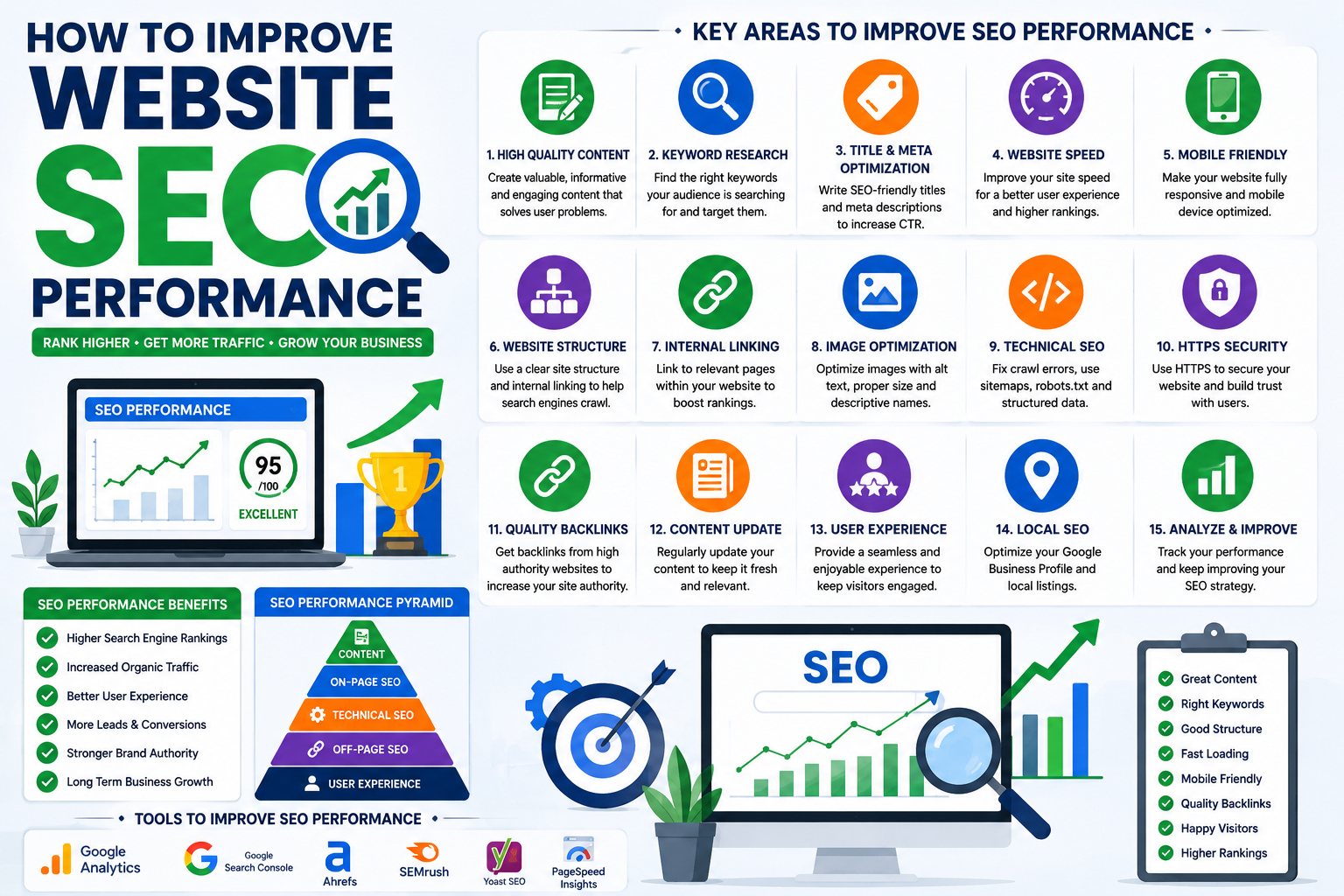
How to Improve Website SEO Performance
Search Engine Optimization (SEO) remains one of the most effective ways to generate long-term website traffic, increase brand visibility, and attract potential customers. Businesses that rank higher in search engine results often receive more visitors, generate more leads, and achieve stronger online growth. However, many website owners struggle with poor rankings and limited organic traffic, leading them to ask an important question: How to Improve Website SEO Performance?
SEO is not a single activity but a combination of strategies that help search engines understand, index, and rank your website effectively. A successful SEO strategy involves technical optimization, content quality, user experience, keyword targeting, website speed, mobile responsiveness, and authority building.
Understanding How to Improve Website SEO Performance can help businesses create sustainable growth by increasing their visibility in search results and attracting highly targeted visitors who are actively searching for their products or services.
Proven Strategies on How to Improve Website SEO Performance
Improving SEO performance requires a comprehensive approach that focuses on both search engine requirements and user experience. Businesses that consistently optimize their websites often achieve stronger rankings and higher conversion rates.
Focus on High-Quality Content
Content remains one of the most important ranking factors in modern SEO.
Search engines prioritize websites that provide useful, informative, and relevant content to users.
Effective content should:
- Solve user problems
- Answer common questions
- Provide valuable insights
- Demonstrate expertise
- Stay updated and accurate
When creating content, focus on helping users rather than simply targeting search engines.
According to Google Search Central, helpful content created for users contributes to better search performance and user engagement.
Conduct Proper Keyword Research
Keywords help search engines understand the purpose of your content.
Successful keyword research involves identifying:
- User search intent
- Industry-specific phrases
- Long-tail keywords
- Low-competition opportunities
- High-value search terms
Rather than targeting only highly competitive keywords, businesses should also focus on specific phrases that closely match customer needs.
A strong keyword strategy helps attract qualified traffic and improve SEO performance.
Optimize Page Titles and Meta Descriptions
Page titles and meta descriptions play a critical role in search visibility.
Effective titles should:
- Include target keywords
- Be descriptive
- Encourage clicks
- Remain within recommended length limits
Meta descriptions should clearly summarize page content and motivate users to visit the website.
Well-optimized metadata can improve click-through rates and increase organic traffic.
Improve Website Speed
Website speed directly affects both user experience and SEO performance.
Slow websites often experience:
- Higher bounce rates
- Lower engagement
- Reduced conversions
- Poorer rankings
Businesses should optimize:
- Images
- Code
- Hosting infrastructure
- Caching systems
- Database performance
Website owners can analyze performance using Google PageSpeed Insights and implement optimization recommendations.
Make Your Website Mobile Friendly
Mobile optimization is essential because a significant portion of internet traffic comes from mobile devices.
A mobile-friendly website should provide:
- Responsive layouts
- Fast loading times
- Easy navigation
- Readable content
- Mobile-friendly forms
Search engines prioritize websites that deliver positive mobile experiences.
Optimize Website Structure
A clear website structure helps both users and search engines navigate content efficiently.
Good website architecture includes:
- Logical page hierarchy
- Internal linking
- Clear navigation menus
- Organized categories
- Simple URL structures
Well-structured websites are easier to crawl and index.
Businesses looking for scalable website solutions can benefit from services such as https://hrweb99.com/web-portal-development that support structured and SEO-friendly website architecture.
Use Internal Linking Strategically
Internal links help distribute authority throughout a website and guide visitors to relevant content.
Benefits of internal linking include:
- Improved crawlability
- Better user navigation
- Increased page authority
- Longer session durations
Each important page should receive relevant internal links from related content.
Optimize Images for SEO
Images contribute to both user experience and search visibility.
Image optimization involves:
- Descriptive file names
- Alt text descriptions
- Proper compression
- Appropriate sizing
Optimized images load faster and provide additional ranking opportunities through image search.
Create SEO-Friendly URLs
URLs should be simple, descriptive, and easy to understand.
Examples of good URLs include:
- website.com/seo-performance
- website.com/content-marketing-strategy
Avoid long, complicated URLs containing unnecessary numbers or characters.
Clean URLs improve usability and search engine understanding.
Focus on User Experience
Modern SEO extends beyond keywords and backlinks.
Search engines increasingly evaluate how users interact with websites.
Positive user experience includes:
- Fast loading speed
- Clear navigation
- Mobile compatibility
- Readable content
- Accessible design
Visitors who enjoy a positive experience are more likely to remain engaged and convert into customers.
Build High-Quality Backlinks
Backlinks remain one of the strongest ranking signals.
A backlink occurs when another website links to your content.
High-quality backlinks can improve:
- Domain authority
- Search visibility
- Organic traffic
- Brand credibility
Businesses should focus on earning links naturally through valuable content and industry relationships.
Publish Content Consistently
Regular content updates signal that a website remains active and relevant.
Content ideas include:
- Industry insights
- Educational guides
- Case studies
- Tutorials
- Frequently asked questions
Consistent publishing helps increase indexable pages and expand keyword coverage.
Improve Technical SEO
Technical SEO ensures that search engines can crawl and understand website content effectively.
Important technical SEO elements include:
- XML sitemaps
- Robots.txt configuration
- HTTPS security
- Canonical tags
- Structured data
- Crawl error resolution
Technical issues can prevent search engines from properly indexing pages.
Optimize Core Web Vitals
Core Web Vitals measure key aspects of user experience.
Important metrics include:
- Largest Contentful Paint (LCP)
- Interaction to Next Paint (INP)
- Cumulative Layout Shift (CLS)
Improving these metrics contributes to better usability and stronger SEO performance.
Use Schema Markup
Schema markup helps search engines better understand website content.
Benefits include:
- Enhanced search listings
- Rich results opportunities
- Improved visibility
- Better click-through rates
Structured data can provide additional context for search engines and users.
Monitor SEO Performance
Continuous monitoring is essential for long-term success.
Important metrics include:
- Organic traffic
- Keyword rankings
- Bounce rates
- Conversion rates
- Click-through rates
Businesses can use tools such as Google Analytics to track performance and identify optimization opportunities.
Reduce Duplicate Content
Duplicate content can confuse search engines and dilute ranking signals.
Businesses should ensure that:
- Content remains unique
- Canonical tags are implemented
- Similar pages are consolidated when appropriate
Unique content helps maximize search visibility.
Optimize for Search Intent
Search intent refers to the reason behind a user’s query.
Content should match the visitor’s goal, whether it is:
- Informational
- Navigational
- Commercial
- Transactional
Aligning content with search intent improves engagement and ranking potential.
Strengthen Local SEO
Businesses serving specific locations should optimize for local searches.
Local SEO strategies include:
- Google Business Profile optimization
- Local citations
- Location-specific content
- Customer reviews
Strong local SEO helps businesses attract nearby customers.
Improve Website Security
Website security contributes to both user trust and SEO performance.
Security best practices include:
- HTTPS implementation
- SSL certificates
- Software updates
- Malware protection
Secure websites provide better experiences for users and search engines.
Keep SEO as an Ongoing Process
SEO is not a one-time project.
Search engine algorithms, user behavior, and industry competition constantly evolve.
Businesses should regularly:
- Update content
- Analyze rankings
- Improve technical performance
- Monitor competitors
- Refine strategies
Continuous optimization helps maintain and improve search visibility over time.
Businesses asking How to Improve Website SEO Performance often discover that SEO success depends on multiple factors working together. Content quality, website speed, mobile usability, technical optimization, and user experience all contribute to stronger rankings and better results.
A well-optimized website attracts targeted visitors, builds credibility, and creates more opportunities for lead generation and sales. Understanding How to Improve Website SEO Performance allows organizations to create a strategic framework that supports long-term growth and sustainable online visibility.
Ultimately, the answer to How to Improve Website SEO Performance lies in consistently delivering value to users while following search engine best practices. Businesses that prioritize quality content, technical excellence, and positive user experiences position themselves for stronger rankings, increased traffic, and long-term digital success.



Leave a Reply